Ads 468x60px

ProBlogger: 10 Simple Hacks That Will Increase Your Blog Traffic

ProBlogger: 10 Simple Hacks That Will Increase Your Blog Traffic

Link to @ProBlogger

10 Simple Hacks That Will Increase Your Blog Traffic

Posted: 12 Jan 2015 06:59 AM PST

This is a guest contribution from Garrett Moon, co-founder of CoSchedule.
Of course, you know that writing more blog posts will increase your blog traffic.
If one blog post results in an average of 200 visits, then two blog posts should magically turn into 400 visits. Voila!
But, that sucks.
What if there was a way to increase your blog traffic without creating more content?
Rather than using two posts to reach 400 visits, what if you could get those same 400 visits from a single post?
The good news is that it's possible. Just recently, we began publishing one less post per week on the CoSchedule blog. Even better, our traffic actually went up. Yes, up!
We did it by better optimizing the traffic we received from each piece of content that we posted online. We decided to blog smarter, and not just harder.
The good news is that you can easily do it, too.
Here are the 10 'hacks' that we used to optimize traffic on our own blog. Most of them will make an instant impact on your traffic growth, so plan to implement a few as soon as you can.

1. Make Your Content More Shareable Using A Click To Tweet Plugin

Everyone has social media share buttons somewhere on their blog, but what happens if you add them in your content as well?

Screen Shot 2014-12-19 at 4.59.41 pm
Click To Tweet links do just that by helping you to create tweetable quotes and comments throughout your post.
The idea is that you are not only providing readers a way to share, but actively suggesting that they do. This naturally leads to more shares and more exposure for your content.
At CoSchedule, we wanted to be able to add these Click To Tweet boxes with a single step, so we made a custom plugin for ourselves and have since decided to distribute it for free. It's easy to install. You can grab it here for free if you'd like.

2. Maximize The Emotional Value Of Your Headlines

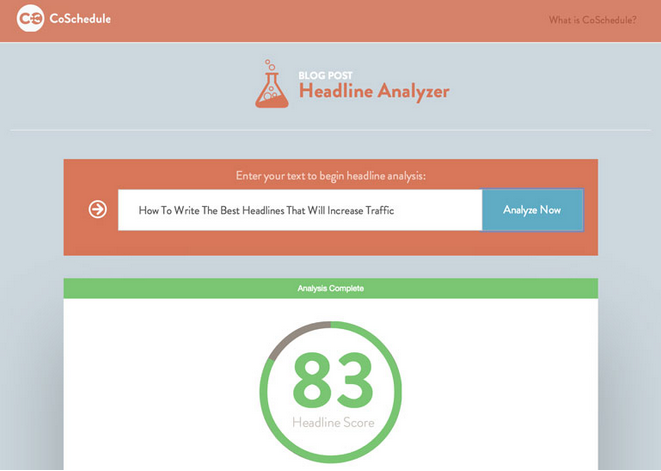
A while back, we did some research on more than 1 million blog post headlines and make a huge discovery—blog posts with more emotional headlines actually result in more shares.
Screen Shot 2014-12-19 at 5.00.33 pm
The takeaway? Write headlines that have stronger emotional output.
There are several tools that you can use to do this. The Emotional Value Analyzer by the Advanced Marketing Institute will give you a basic rating on the emotional value of a headline.
The Blog Post Headline Analyzer will do the same, but also give you a rating on the overall quality and length of your headline. It should make it easy for you to to write awesome (and emotional) headlines every time.

3. Create Longer-Form Content

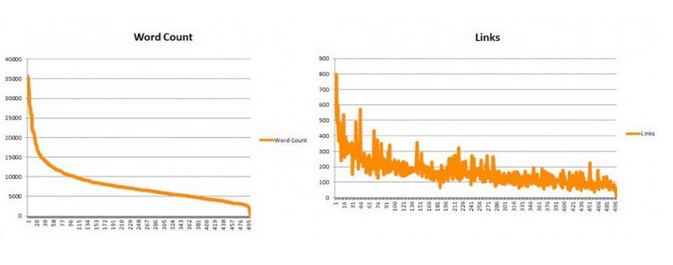
Did you know that Google gives precedence to long-form content in its search results? By long-form content, I mean posts that have a total of 2,000 words or more.
Screen Shot 2014-12-19 at 5.01.12 pm
Oye!
In a recent post, Neil Patel outlined Google’s trend towards long-form writing. He found that long-form content was more likely to be linked to from another site, and it was more likely to take the top spot in search results.
Not a bad deal for a few hundred (or thousand) extra words.

4. Improve Your Meta Tags And Rich Snippets

There are a ton of things you can do to your blog to make sure that your content looks as good as possible when it's shared on social media or picked up by search engines like Google.
Most of this relies on a small bit of meta tag code that you should include in the <HEAD> of your html page. This code will provide instructions to networks like Twitter, Facebook, Google+, and Pinterest by telling them which image, title, and description to use when a post goes live.
You can even preview what your own link previews look like using this handy debug tool provided by Facebook.
If you’re using WordPress, the Yoast SEO plugin is a great way to make sure that most of it happens automatically. By making sure your content looks as good as possible when it's shared, you will increase your blog traffic with ease.

5. Tell A Better Story

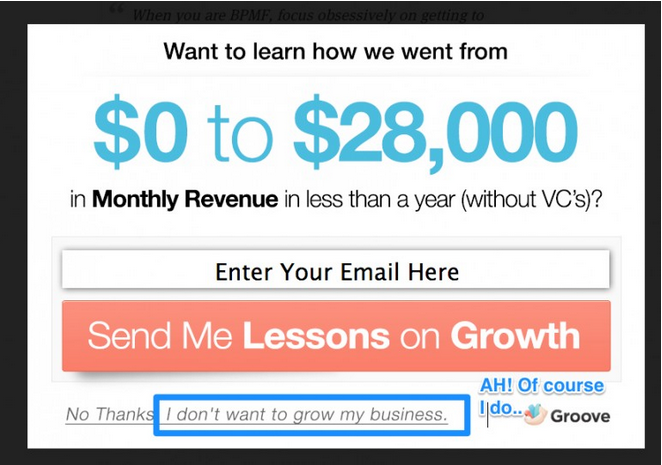
In 2014 helpdesk software maker Groove shut down their content marketing blog after seeking a solution that would bring them more traffic. Groove decided to shift their content from "generic evergreen content" to the story of their own success.
Screen Shot 2014-12-19 at 5.02.09 pm
Groove relaunched their blog as a step-by-step telling of their journey from $20k in revenue per month to more than $100k.
As it turns out, the relaunch worked! In the first five weeks of the new blog, Groove gained 5000 new email subscribers instantly, and gave us all a lesson in the power of storytelling.
One way to increase your blog traffic is to actually tell your story!

6. Promote Your Content On Social Media More Than Once

One of the biggest mistakes we make as bloggers happens right after we press the "publish" button. Once a blog post goes live, too many of us only share our posts once or twice on social media—even though we are frequently producing evergreen content.
Screen Shot 2014-12-19 at 5.04.03 pm
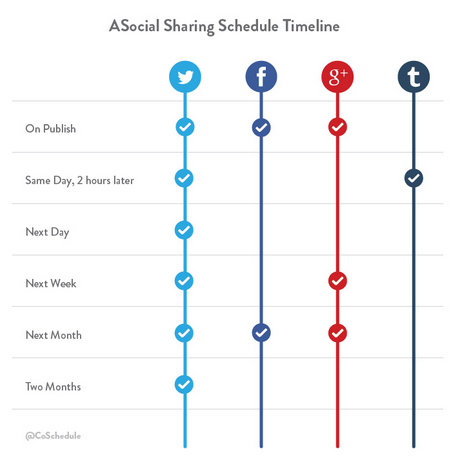
The trick here is to follow a simple pattern to promote your content on social media.
  1. On publish – Social messages publish when your blog posts go live.
  2. Same day – Initial social messages trickle out to your accounts throughout the next 2–3 hours.
  3. Next day – Messages are shared again on the appropriate social channels.
  4. Next week – Another series of messages are pre-scheduled and sent the following week.
  5. Next month – More social messages are pre-scheduled for the following month. This is especially important for evergreen content.
  6. Next _____ – Additional messages can optionally be scheduled for the three-month mark or beyond.
By the way… make sure you add some variety to your social content so you don't come off as just another spammer. You can read more about this whole process here.

7. Make Your Blog Load Faster

Did you know that Google considers the speed of your website when ranking your website in search results?
Back in 2010, Google engineer Matt Cutts announced that Google is now factoring site speed into search rankings. So, it only makes sense that you would make your blog as fast as possible.
If you aren't careful, you can easily add a bunch of crummy plugins and themes that degrade your site's performance over time. It's important to spend some time reclaiming that speed and improving how you rate on Google.
While it can be a bit technical, WPMU DEV has a great guide for speeding up your WordPress blog. Follow it, speed things up, live long and prosper.

8. Optimize Your Social Sharing Buttons

Do you know where the best place to put your social media buttons is?
The placement of these buttons can actually make a big impact on how many shares your posts receive. Our research has found that they seem to do best near the top left of the page, but you can use this free heat map tool from SumoMe to find out how readers interact with your pages.

9. Clean Up Your Sidebar

One of the fastest ways to make a big impact on your blog is to simply clean up your act. After a bit of time, most blog sidebars start getting pretty congested with ads, links, and other cool widgets.

Screen Shot 2014-12-19 at 5.05.33 pm

But, those widgets aren't so cool if they're distracting your readers from what they should really be doing. Take a minute to really decide what you want your readers to be doing and remove any clutter that you can.


10. Improve Your Call To Action


One way to determine if a widget belongs on your blog is to ask yourself if it is contributing to your bottom line.


At CoSchedule, our blog is set up to lead readers to only two different calls to action. Users can either sign up for our email list or try CoSchedule. It's that simple!


Have a  a clear call to action, and a blog layout and design that accurately leads your readers to it. This is a guaranteed way to improve your blog traffic and conversion rate.


Garrett Moon is a co-founder at CoSchedule, a social media editorial calendar for WordPress that allows users to schedule blogs posts and social media on an easy drag-and-drop calendar. He blogs about social media and content marketing every week on the CoSchedule Content Marketing blog. You can follow him on Twitter @garrett_moon.

Originally at: Blog Tips at ProBlogger
Build a Better Blog in 31 Days

10 Simple Hacks That Will Increase Your Blog Traffic

ProBlogger: SEO: The Must-Dos That You Just Can’t Miss

ProBlogger: SEO: The Must-Dos That You Just Can’t Miss

Link to @ProBlogger

SEO: The Must-Dos That You Just Can’t Miss

Posted: 08 Jan 2015 06:28 AM PST

Last year, we had Rand Fishkin sort us out with a comprehensive post on SEO basics, tips, and tricks. If you haven’t thought much about SEO and the traffic it can bring your blog, now would be the time to do it! Get into the right habits at the start of the year, and they’ll become second-nature.


We welcome Rand Fishkin to the ProBlogger Theme Week today to talk us through all things SEO. While this week we’re exploring all the things you can do with a post after you hit “publish”, Rand is reminding is to take a second before we do and have a look at the things you can do to optimize your post before it even gets into the hands of your readers.

For days, you’ve been agonizing over this post. The hours of guilt for not starting it sooner, the toil of finding the right topic, the relentless editing and re-editing, and now, at long last, the publish button is there, tempting you to end the struggle and at last declare this tiny battle over.

publish-button
(above: the blogger’s tantalizer, teaser, needler, and tormenter)

If you give in to that sweet release, it will feel good, at least for a little while. But in the months and years to come, you’ll look back at that post and, perhaps in revery, read it again, and think to yourself:

“That was a really excellent post I published. Why has it had so little success?”

It started so well. The post had some retweets on Twitter. It got shared and liked a few times on Facebook. Maybe it even got a bit of traffic from Google+ or Pinterest. But, then, the traffic stopped. Your post wasn’t “new” anymore, and the web world, it seemed, no longer cared for something more than 24 hours ago. In fact, the data backs this up – social sharing half-lives across networks are <7 hours.


spike-of-hope

There is another way.

The vast majority of content consumed on the web isn’t actually found through social media. In fact, the largest driver of traffic to web content (outside of direct navigation) is still the same source it was 3, 5, and 10 years ago, and remarkably, in spite (or perhaps in part because) of the rise of social & mobile, this source is still growing.

You’ll probably recognize it:

google-search-box

Search, and Google in particular (with 90% of worldwide share), still drive vastly greater quantities of traffic than all the social networks combined (some good research from DefineMG here). Given Google’s 3.5+ Billion searches performed each day, that shouldn’t be a surprise, but to many bloggers, thinking about search, Google, and all that “SEO stuff” has been put aside in favor of Facebook shares, likes, tweets, +1s, and the more visible feedback and applause that come from social sources.

That bias is understandable – a visit from a Google search doesn’t have a fancy embeddable counter you can show off. 30,000 visits a month from search engines doesn’t carry nearly the same social proof that 30,000 Twitter followers does.

But, it should.

The vast majority of visitors who come via social have a browsing-focused intent. They’re looking for something interesting, distracting, temporal, and, only rarely, directly or immediately applicable to an activity that will lead to them accomplishing the goals you’re hoping for on your website (a subscription to your posts, a following of your social accounts, purchasing your products, etc).

On the other hand, searchers know exactly what they want and when they want it – right now. Almost no searches are entirely serendipitous, but most every social visit is entirely so. A searcher is seeking to find information, accomplish a task, or transact in some way right this minute. That’s why they performed a query. If your blog post (and your website, more broadly) helps them achieve this goal, the value of that visit to both parties can be fantastic.

Here’s the tragedy:

When you look over those past posts, you might realize that yes, dammit! It’s time to do some SEO! No more ignoring Google, Bing, Yahoo, and the rest. But, sadly, that ship has probably sailed. One of the harsh truths of blog-focused SEO is that a few hours after a post is published, 90%+ of the ranking ability is spent. Sure, you could go back and tweak some titles, language use, or even URLs (depending on your CMS), but those don’t have a good chance of helping the post perform moving forward.

It’s that first burst of activity – of social sharing and people emailing it around and links coming in – that set the stage for ranking success in the search engines. The words, particularly the title, of the post are how others will describe it when they share, link, tweet, and pin. Those words are strong signals to search engines of how and whether to include your page in the search results. Likeiwse, the first few hours are when you’re most likely to earn that attention and awareness of potential linkers. Links are still a huge part of how search engine algorithms rank pages, and without them, you’ll usually struggle to perform. Both of these are short-lived opportunities on which you need to execute if you’re going to have SEO success with your blog.

Thankfully, you can resolve to make this a priority in the future. It may sound like a bad infomercial, but you can substantially upgrade your blog’s SEO potential with less than 5 minutes per post. Here’s how:

  • Step 1: Keyword Research
  • Step 2: Post Title & Body Content Inclusion
  • Step 3: A Teensy Bit of Proactive Outreach

Step 1: Keyword Research

Earning additional search visits from the content your blog produces over a long streth means ranking for a keyword term or phrase that gets at least a few queries each month. You probably don’t want to tackle competitive phrases where you’ve got little chance to rank on page 1, but you also don’t want to to be ranking brilliantly for a search term no one ever types. In general, phrases with fewer searches are going to be less competitive (if you want to get more data-driven about analyzing the relative difficulty of ranking for a keyword, there’s a tool for that).

Google’s Keyword Planner Tool is still the best one out there to show relative volume levels. Here’s what it looks like:

adwords-kw-planner1

I plugged in a few possible searches related to the post you’re reading now (which is, in a very meta way, about doing SEO for blog posts). The suggestions you see above are what Google’s keyword tool returned. They expanded on a few of my ideas and showed me some terms I wouldn’t have otherwise thought to put in. But, before we go further, there’s four important points to be wary of when you’re looking at the Keyword Planner:

adwords-kw-planner2

A) These aren’t ALL the terms and phrases Google knows are related to your keyword(s). For whatever reason, they’re not comprehensive and, on any given search, may omit numerous good options. This is why it pays to refine and rerun once or twice, and to expand your brainstorm list of terms. It’s also why I’ll suggest using another methodology in combination with Keyword Planner below.

B) The numbers you see are not accurate. We’ve seen them show numbers that are 1/4 of the actual searches for a term and we’ve seen them show 4X the real figure. What is useful are the relative quantities. If Keyword Planner says term XYZ gets twice the searches that term ABC gets, you can be fairly sure that XYZ > ABC. Don’t panic about choosing a term with only 10 or 20 searches/month. These low numbers are actually where we see the least competition and the least accuracy from Google in under-reporting real volume.

C) This “competition” does not refer to how hard it might be to rank in the organic results for a given keyword. Keyword Planner is showing a competition level that’s related to AdWords bids and how many campaigns are targeting these terms. Don’t be too discouraged if it says “medium” or “high” as the organic results won’t always reflect what the paid ads do.

D) Likewise, the cost column can be mostly ignored when thinking about SEO. The one area it can be helpful is to provide a sense of how transactional in nature the search query is, and the value of that traffic to others. If you’re thinking about offering ads on your blog, for example, you might want to note how much advertisers are paying to be in front of searchers for a keyword related to your topic(s).

The other keyword research source I’d encourage you to pursue is Google’s autosuggest. It often illuminates keyword ideas that you may not have seen through AdWords Planner. In fact, some of the best terms and phrases to target are those Keyword Planner hasn’t listed, but autosuggest does (this is because many other SEO-focused content creators have likely missed them).

blog-seo-autosuggest
Start typing, but don’t hit enter!

Step 2: Post Title & Body Content Inclusion

Once you’ve found a few keywords that might work, modify your blog post’s title to include it if you can. For example, when I started drafting this post, I titled it “Publish Now And 1000s of Visits Will Be Forever Lost.” It had a catch and it matched the tone I was aiming for with the piece, but it didn’t target any of those lovely keywords that can help it potentially earn visits for years to come. So I thought up three more:

  1. Publish Your Blog Post Without SEO, and 1000s of Visits Will Be Forever Lost
  2. Your Amazing Blog Post – SEO = 1000s of Lost Visits
  3. These Simple SEO Blogging Tips Will Save You 1000s of Lost Visits

Even though I don’t like #3, it’s probably the best optimized title (note that Google is pretty smart these days about interpreting modifications of words like “blog” and “blogging” that have the same meaning/intent). But, that doesn’t mean I’ll choose it. As I noted above, a lot of a post’s potential success is based on its ability to get in front of the right eyeballs. A title that’s optimized for keyword placement but doesn’t resonate with social sharers and potential linkers isn’t worth compromising for. Instead, I’d go with #1 or #2 and I happened to like #1 just a bit better.

The only other part of this step is to make sure the post itself has at least a mention or two of the target keyword phrase and is actually about that topic (nothing infuriates searchers more than discovering a page ranking in Google that’s not actually about what they wanted – and those user/usage metrics will, eventually, hurt your rankings).

Step 3: A Teensy Bit of Proactive Outreach

Chances are that when writing your post, you mentioned someone, used a graphic or image from somewhere else, linked to some reference-worthy content on another site, or called out a service or organization in some way. If you believe there’s any chance that they (the referenced party) would be interested in reading what you’ve written about them, don’t be shy – let them know.

Twitter makes this incredibly easy (and Google+, too, for those of you using that service). In this post, for example, I referenced a study from Bit.ly, some search stats from Statcounter, and a great post from Define Media Group. Immediately upon hitting publish, I should tweet, G+, and/or email all three of them and say thanks, making sure to point them in the direction of this post. Maybe they’ll share it, maybe they won’t, but they’ll know I appreciate their work, and that goodwill might be valuable in the future, too.

Likewise, if I know there’s a few people in my network or among those that I follow/interact with on social media or the offline world who might benefit from or enjoy this post, I should drop them a line, too.

This might be 30 seconds of thinking about who to contact and another 2 minutes sending the messages, but the reward for that effort could mean the difference between a post that spreads, earns links, and ranks, and one that falls into the tragic “Flatline of Nope.”

———–

A few last pieces of advice:

  • Don’t worry too much about targeting a keyword phrase in more than one post. If at first you don’t succeed, try again! Google has no penalty for a blog that publishes 3-4 posts all chasing the same keyword. The only time I might not do this is if you’re already ranking very well for a term/phrase, in which case, I’d consider updating the old post vs. writing a completely new one.
  • Updating & re-publishing can be a super power! If you’ve got a post that did well, but didn’t quite make it to the first page of results, consider revising it, adding in the most modern information, and publishing a new post to replace the old one. You can use a 301 redirect or rel=canonical tag to point search engines from the old version to the new one.
  • If you need inspiration for titles or content in niches where you think there’s just nothing exciting to write about, I can’t recommend Buzzsumo enough. Give the tool a spin with a few searches related to your potential topics and you’ll see what I mean.
  • Not every post needs to be or should be SEO-targeted. Writing for your audience, for yourself, or simply to court serendipity is a wonderful thing. But every few posts (or at least every few dozen), think about all those poor souls who are searching and finding none of your amazing work – do it for them :-)

p.s. A couple years ago, I created a presentation centered around my love for bloggers and blogging entitled: How to Earn Traffic Without Selling Your Soul. If you’re worried that SEO means sacrificing the beauty of your work, check it out – it may just restore your faith that the two can live in harmony.

Originally at: Blog Tips at ProBlogger
Build a Better Blog in 31 Days

SEO: The Must-Dos That You Just Can’t Miss