Ads 468x60px

ProBlogger: Learnings from My Pinterest Experiment

ProBlogger: Learnings from My Pinterest Experiment

Link to @ProBlogger

Learnings from My Pinterest Experiment

Posted: 19 Aug 2012 07:02 AM PDT

Over the last couple of days I’ve begun to play with Pinterest again. It’s been ages since I first set up an account but when I did I didn’t really really click with it. Interestingly, despite not being active on it, I seemed to gather followers til it got to 1000.

PinterestI also saw some decent traffic from Pinterest to our photographic tutorials on dPS. I guess our articles are just naturally pinnable, as we have a lot of images. Pinterest has been sending us around 40,000 visitors a month, which is nice, although not a massive amount in the scheme of overall traffic. In terms of social media traffic, it comes in behind Facebook, but ahead of StumbleUpon and Twitter.

An experimental strategy

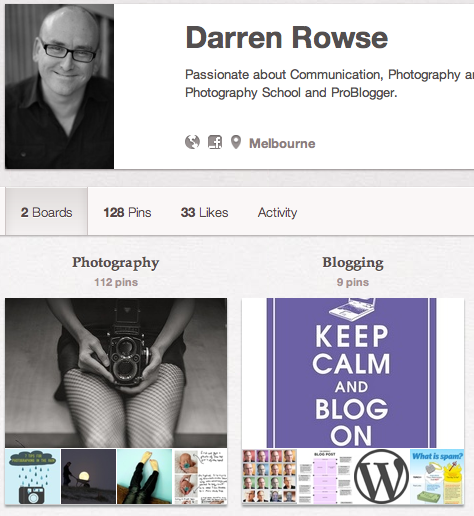
Given than we’ve gained decent traffic from it, I decided to start playing with it this week to see what I could learn. My strategy has been very simple and very primative so far and has centred around a photography board on my personal account. There, I’m simply sharing the following:

  • photos that I love
  • tutorials from other sites that I think are good
  • a few of the better tutorials from dPS.

The links to dPS are in the minority, but over the last few days I must have pinned 20 or so items from the site. I’ve also done a little liking and commenting on a few other photography-related Pinterest boards—but not heaps!

Preliminary results

It hasn’t been long, but in the time I’ve been experimenting, I’ve seen some interesting results.

  1. Follower numbers are up around 450. I did link to it from my Facebook page and Twitter account, but most of that growth has just steadily come in (I’m guessing) mainly as people repin my images.
  2. I’m seeing decent repinning. The numbers aren’t huge, but already I’m seeing some nice traction on some of the pins I’ve put out there. Actually, I’m fascinated to see what is and isn’t getting repinned. Obviously its largely about the image, but  tips-related pins seems to be getting traction. I’ll continue to experiment to see what more I can glean about what’s working over time.
  3. I’ve noticed an increase in Pinterest traffic coming to the site, but given that I’ve only pinned a handful of dPS, stuff I wasn’t expecting much.

    Pinterest's traffic impact
    In fact, a couple of days after my experiment began, we had the biggest Pinterest day of traffic for dPS since May. While we were averaging about 1400 visitors a day over the last couple of weeks, but it increased to around 2100—not a massive boost, but encouraging. Follower numbers at he time of writing had also steadily grown to more than 1600 for that board.

  4. Reader engagement, as shown by the comments on some of my pins, was interesting. Followers were mainly asking questions. On one pin (on a set of images), a follower asked if I knew of any tips for a particular type of photography. I was able to link to a dPS tutorial on that topic in a reply to her comment.

I’m seeing quite a few opportunities here and have committed to take my Pinterest activity to the next level over the coming weeks. I’m not going to reveal what we have planned yet, but you can expect to see dPS on Pinterest in a more formal way in the near future (I’ll share what we do when that happens).

Update: now a week into this experiment I can compare traffic for the last week from Pinterest to the week before.

The blue line is this last week of referred traffic from Pinterest – the orange line is last week’s referred traffic from Pinterest. While it goes up and down from day to day (the last two days have been weekend traffic) you can see we’re up to 7 days of increased traffic on the previous week.

The increase is 38.94% on the previous week with Friday being up by 91% on the previous Friday.

While this isn’t a massive rise in terms of our overall traffic for the site the signs are positive. Even if we just sustain this increase for the next 12 months it is an extra 200,000 visitors to the site over the year (of course I hope we can ramp it up further with some further new strategies that will be implemented this coming week).

Straight to the source!

For those who don’t know, Pinterest has a Source page that shows you the most recent pins made to a site. For example, the dPS source page is at http://pinterest.com/source/digital-photography-school.com/

To find yours, just substitute the dPS URL for your blog’s URL in the link above. If you don’t have much pinning action on your blog, you might not have one yet, but quite a few of the small blogs I tried it on did.

On this page, you can see all the pins that people have made for articles on Digital Photography School. The page doesn’t seem to update minute by minute, but it is relatively up to date.

This, my friends, is what I consider gold information! There are many possibilities for how you can use this:

  1. Share this page with your community: I linked to this page a few months back on the dPS Facebook page with a call to action like, “See what’s hot on dPS right now.” I noticed a rise in traffic to dPS that day (and an increase in pinning action too).
  2. Research what type of posts are pinnable: Watch this page and you’ll quickly see what kind of articles readers find pinnable. Create more of them!
  3. Add Pin buttons to your hot posts: I’m currently getting a redesign of dPS done that will include Pinterest buttons on every page on the site. But while I’m waiting, I’ve manually added them to the pages on dPS that are getting the most pins—this page helps me to find them (so too does digging into your Google Analytics account). By adding this button to the right pages, you make the post more pinnable—so when people arrive from Pinterest they’re more likely to pin it themselves.
  4. Networking opportunities: Another benefit of this page is that you can see who’s pinning your stuff. What a perfect place to watch and thank those who are pinning your work with a quick comment. This is an opportunity to network with your readers, and not just any readers, but those who are evangelists for your blog!

Knowing what content on your site is being shared is great information. How are you using Pinterest to engage, and engage with, readers? Share with us in the comments.

Update: if you’d like a sneak peek at Phase 2.0 of the dPS Pinterest experiment take a look at our brand new dedicated dPS Pinterest account which I’ll write more about in the next week.

Originally at: Blog Tips at ProBlogger
DMS_468x60_LS_banner4.gif

Learnings from My Pinterest Experiment

“How to Succeed in the Video Game Blog Niche” plus 1 more

“How to Succeed in the Video Game Blog Niche” plus 1 more

Link to @ProBlogger

How to Succeed in the Video Game Blog Niche

Posted: 18 Aug 2012 01:06 PM PDT

This guest post is by David Edwards of A Sitting Duck.

Candy

A screenshot from my game, Candy

This year was a land mark year for A Sitting Duck. What started as a blog and creative community has evolved into a limited company that is on track to publish a multi-platform game very soon.

As John mentioned yesterday, gaming is a large and growing niche, with a massive, very passionate audience. It’s a great space to operate in as a blogger, and a business person.

Top tips for succeeding in the video game niche

Over the last four years I’ve moved from illustrations to animations, and now to interactive gaming. I guess as a blogger/publisher the focus for me has always been to build engaging, free content which then makes it much easier to sell services and products.

Here are my tips to build a successful blog in the video game niche.

  • Start with big games: It's really important if you want search engine traffic that you write reviews on (or otherwise cover) the big games up front. Sure, the big blogs in the niche will cover them, and they’ll probably get first position in the search results. But often, you can get hits from angles they didn’t cover, like " How To Pass Level 50 On Angry Birds".
  • Use big pictures and tweet them: By adding the picture from your latest blog post to Twitter, you'll get instant attention—and the chance to suggest that there are more to look at over on your blog.
  • Embed game trailers from YouTube and describe what happens on the video: This is such an easy thing to do, and it’s sure to get you extra traffic that the video producers will miss out on, because they’re busy working on more videos!.
  • Make your own videos: It’s no surprise that top video game blog IGN Entertainment  has produced thousands of videos: it works! Video gamers want to see how the game plays, and without actually playing it, a video is the closest they'll get to the experience. Your best bet is to have a look around for a high-quality capture to stream, and save footage from the XBOX, Playstation, Wii and so on.

Trends do change with blogging, but from what I've seen in the video games market, the current popular formula is: upload a video to YouTube, produce a short post blog with extra images, tweet, and find another game to repeat the process with!

Monetization

The Candy Menu

The Candy menu

When it comes to making money, development companies like Thegamebakers.com use a blog to capture a free audience to save money on banner advertising, and sell their own games.

Large video game blogs sell ad space, from a bespoke full skin (like Pocket Gamer), where they fully re-brand the home page to promote the sponsor’s game, to the regular box ads at a more reasonable price.

Monetization gets interesting when you look at the smaller blogs in this space (avergaing 5,000 – 50,000 hits a month). These guys usually go for the approach of selling paid reviews, where developers pay, say, $300 to look at your game and write a positive or neutral review of it (it’s never bad—hence the fee!).

If you did ten or more reviews a month, it would start to work out as a full-time salary. Pocketfullofapps.com is a great example of this approach in action, and that blog’s founder is looking to expand quickly over the coming year.

What are you waiting for?

Overall I’d say you should start off by building up your volume of blog posts and video catalog, as this market is very much focused on quantity rather than quality, thoughtful stuff.

Then, once you have that base, work with other active blogs on videos, get them in on the commentary, and you'll have the kind of banter that really brings in the video views (thousands, and in some cases millions!).

David Edwards is the founder of http://www.asittingduck.com and produces animations over at www.youtube.com/asittingducktv.

Originally at: Blog Tips at ProBlogger
DMS_468x60_LS_banner4.gif

How to Succeed in the Video Game Blog Niche

Stand Out in the Popular Pet Blogging Niche

Posted: 18 Aug 2012 07:03 AM PDT

This guest post is by Kimberly Gauthier of Keep the Tail Wagging.

When I was planning the launch of Keep the Tail Wagging, I heard the question "Do you know how many pet blogs are out there?” As John pointed out yesterday, this is a big niche, with a lot of competition.

But when I was asked this question, I would simply smile politely, while thinking, "Who cares?!” I'm not one to run away from a challenge; I'd been blogging since 2009 and planned to put everything I'd learned into practice on my new site.

Keep the Tail Wagging launched January 1, 2012.  In less than six months, I had a page rank of 2 (I'm convinced I deserve a 3 or 4), over 5,000 likes on Facebook and over 5,000 followers on Twitter.

Succeeding as a small fish in a big pond

To anyone looking to start a blog in a popular niche, don't let the crowds discourage you.  It is possible to carve out your own section of the pond.  I get emails daily asking how I've managed to build Keep the Tail Wagging's following and it was actually pretty easy. I've boiled my success down to five things that I do consistently.

1. Keyword research

Before Keep the Tail Wagging was launched, I downloaded a free version of Market Samurai to help me find an opening within the niche that could be monetized. I didn't find the opening I was looking for.

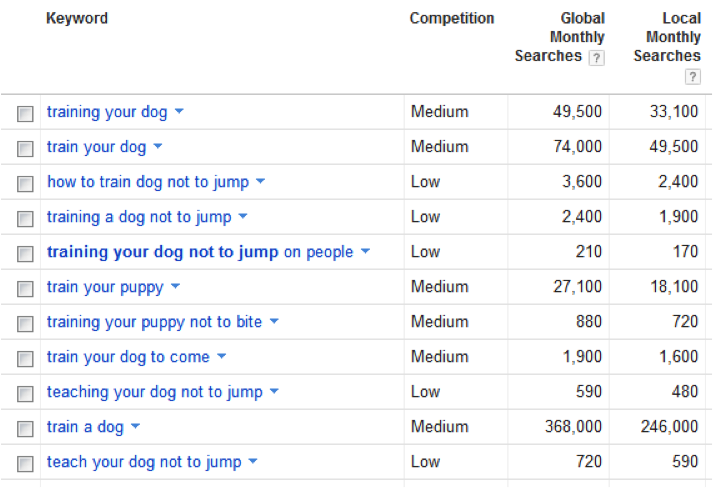
But, using the free Google Keyword tool, I did find keywords with the right combination of competition and searches, and I apply these to each blog post I wrtie.

Keyword research

It’s a thrill to know, for example, that a dog owner researching her dog food options found my site through a Google search; this let me know that I was choosing the correct keywords for my audience.

2. Simple SEO

I remember the "Of course” moment that struck when I realized that I could put keywords in the captions and meta-tags of my images.  I'm not an expert in search engine optimization, but I do comprehend the basics and use the plugin WordPress SEO, and I invested in an SEO-friendly, premium WordPress theme.

SEO doesn't have to stop on our sites; I send those keywords to every site that uses my content—Flickr (as in the image below), Pinterest, and Stumble Upon to name a few.  Any content or site that's going to be indexed by the search engines is another opportunity for someone to find my site.

Not only is this great for Keep the Tail Wagging; properly tagging on social networks also benefits the pet companies that send me products to review.

Flickr Walk in Sync Image for ProBlogger

3. Promote like hell

I spent the first two months after launch on a PR campaign to make my site stand out.  To start, I told friends and family, handing out business cards, hung flyers, wrote press releases, and added links to my email and forum signatures.

I paid for a Facebook advertising campaign during the first month my site was live. It asked people to click Like if they're tired of long commercials showing abused animals.  My first few hundred likes came from that campaign—and those clicks led to more referrals.

Facebook Ad

Then I discovered Reporter Connection as unexpected PR sources. People became curious about Keep the Tail Wagging after seeing my regular inquiries and began to check the blog out.  During my second month, a PR professional was promoting my site to friends for free.

I landed several interviews and, most recently, a monthly feature on a local podcast about pets through these sources.

4. Interact with fans

I focus most of my time on the fans that liked my Facebook page, encouraging interaction, and getting feedback and article ideas.  Word of mouth is big on social networking sites and each week, friends of fans stop by to like my page.

Creating that back-and-forth made people feel comfortable to email me with questions about their dogs, which inspired articles I wrote for Keep the Tail Wagging.  We're told to become authorities in our niche. Well, what better way to do that than to answer questions asked by our fans?

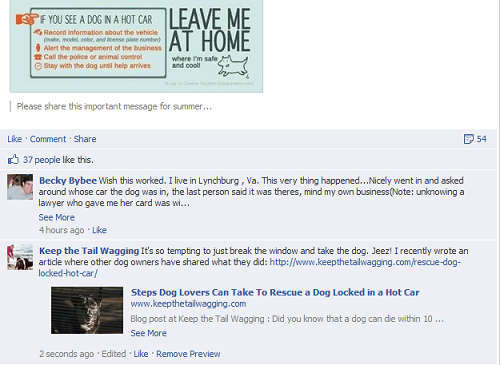
Leave Dog At Home

Over time, I got over my shyness and started asking people to tell their friends about my blog, share a post, and comment on an article or status update.

What makes a blog stand out is the blogger

I chose to be more personable with Keep the Tail Wagging followers by sharing my daily life with them (pictures, stories, frustrations).  My followers came with me when we fostered our first dog, when we lost our puppy to Canine Parvovirus, and when Blue joined our family.

Sometimes it's the person, their writing style, or their short and sweet posts that makes a blog sing. There's a reason why we choose to read some social media or photography blogs instead of others.

I'm not the most popular pet blogger.  I need to work on my bounce rate and I'm on the lookout for regular guest contributors.  But as to my success in the first six months of blogging in this niche, I'd have to say "Not bad.”

That said, we’re all learning every day. Do you spend any time on pet blogs? Do you operate in a similar niche? Share your tips for success with us in the comments.

Kimberly Gauthier is the Editor in Chief of Keep the Tail Wagging, an online magazine for dog lovers.  She's also featured on Girl Power Hour as The Fur Mom and the podcast Your Pets, My Dogs.

Originally at: Blog Tips at ProBlogger
DMS_468x60_LS_banner4.gif

Stand Out in the Popular Pet Blogging Niche