Ads 468x60px

How To Deal with Trolls and Rude Comments - DailyBlogTips

How To Deal with Trolls and Rude Comments - DailyBlogTips


How To Deal with Trolls and Rude Comments

Posted: 19 Jul 2012 05:01 PM PDT


Call me an idealist, but I believe in open blog commenting. Anonymous comments, harshly critical comments (even if they attack me personally), and controversial comments are always allowed on my blogs because I feel that censoring them would restrict an open exchange of ideas.

However, despite my idealistic beliefs on censorship, I’ve learned the hard way that allowing a total comment free-for-all is bad for business. Completely unregulated comments can quickly devolve into a low-quality exchange that your loyal blog readers won’t enjoy, not to mention that “bad” comments can distract you and take control of the conversation around your site.

So, after more than five years of blogging, I’ve come up with a system for managing comments that I feel strikes a balance between open exchange and effective blogging. Here’s how it works and how my team and I implement this policy on the blogs we manage.

Rule #1 – You Need A Comment Policy

One of the many blogging mistakes I’ve made over the years was failing to have an official blog comment policy. Comment policies are important because:

  • Believe it or not, some bad commenters genuinely don’t realize that they’re acting inappropriately. These people don’t have a filter, which is why they’re so obnoxious in the first place.
  • Your loyal readers like a stated comment policy – it gives them permission to help you police your site and report bad actors.
  • It gives you the confidence to deal with negative comments in a consistent manner without fear of reacting emotionally.

Prior to implementing this blog comment policy on TundraHeadquarters.com, I had a lot of personal difficulty moderating comments because of my views on censorship and my fear that I might be reacting emotionally. Rather than deleting or editing comments that were clearly over the line, I just admonished the commenters for being inappropriate…which only inspired them to comment more often. I spent a lot of time and energy dealing with these people, most of which was wasted.

Even worse, my hesitation to deal with inappropriate comments in a fair, uniform manner was beginning to alienate my core audience. I noticed that some of my loyal visitors were commenting less frequently, and on many occasions I received an email from a loyal blog reader who was irritated by the way I was managing comments – a sure sign that I was losing readers because I refused to set boundaries.

When it comes to writing a comment policy, there are two critical components:

  1. Commenters must leave a valid email address
  2. Comments must be conversational

The first component is brutally simple: If a blog commenter won’t own up to their own speech in even a minor way like sharing a valid email address (which is basically anonymous anyways), they don’t need to be taken seriously.

The second component addresses comments that are designed to “stir the pot” and/or people who don’t have any sense of accountability. These "pot stirrers" (a.k.a. trolls) will frequently focus on comments made by others without responding to anyone who addresses them directly. If you add the "conversational commenting" rule to your policy, you can eliminate most of the boorish behavior.

Rule #2 – Avoid and Diffuse Confrontation

When I first started blogging, I enjoyed confrontational commenting. However, a few years later I began to recognize that confrontation isn’t effective at building an audience or growing credibility. Today, whenever someone leaves a critical comment about a blog post author and/or the content of a post, we use the following process.

1. Recognize and validate differing viewpoints (if only partially). When someone leaves a critical comment, it’s important to try to find some validity in their viewpoint. I start by saying something like “I can definitely understand where you’re coming from in regards to [issue], but here’s why I don’t agree…”.

Taking time to validate opposing viewpoints has been great because it has encouraged more commenting – it’s opened the door for others to agree or disagree. It’s also helped me become a better blogger by forcing me to re-evaluate my own point of view.

2. Don’t anticipate a conflict. It’s easy to find yourself planning for a confrontation whenever someone leaves a critical comment on your blog. However, this is a bad practice in blogging (not to mention life in general). Defensive responses to critical comments often create a confrontation. Instead, take every comment at face value and don’t try to defend yourself against attacks that haven’t happened yet.

3. Implement a zero tolerance policy for personal attacks between commenters. When someone attacks the post author personally, I don’t automatically delete their comment. I feel that part of a blogger’s job is subjecting themselves to personal attacks. After all, if a blogger isn’t willing to accept a little criticism, they have no business sharing their opinions so openly.

However, we do not allow personal attacks directed at anyone other than the author. This keeps blog comments civil, and – perhaps not coincidentally – since we implemented this rule, the number of personal attacks directed at blog post authors has fallen as well.

Rule #3 – Deal with Trolls Swiftly

If I were to define a troll, I would say that it’s a blog commenter who has absolutely no interest in conversation. They’re angry, they’re arrogant, and they’re unwilling to acknowledge any other opinions or points of view. They’re the worst the Internet has to offer.

Whenever you start to see a troll-like pattern, you need to respond to it swiftly. Here’s what I do when I think I’ve found a troll:

1. When I first suspect a troll, I email them personally. I thank them for commenting, and then ask them to review the comment policy for me. Sometimes the people I contact are so shocked by the personal outreach that they apologize, but more often they just disappear, never to be heard from again.

2. Public warning only after personal contact. If my personal email doesn’t change a commenter’s behavior (or if they haven’t provided a legitimate email address), I will warn them publicly to adhere to the comment policy.

3. Probation via moderation. If these two steps fail, it’s time to put them on probation. I add the commenter’s name, email address, and IP address to my blog’s moderation queue, ensuring that the only way they can comment freely is to change computers and call themselves a different name.

4. Ban the IP when all else fails. Finally, if the commenter is indeed a troll and no amount of moderation seems to stop them, I ban their IP address from the site by adding a few lines of code to my htaccess file.

A note about step #4: IP banning is hazardous because you can accidentally ban innocent readers, but the instructions in the link I provided will help you avoid this possibility as well as give you a fail safe just in case you ban a legit reader (full disclosure: I own YouHaveBeenBanned.com, but I created it as a public service and it’s completely free).

While I don’t think of myself to be a blogging expert, I like to think I’ve made enough mistakes to help others avoid potential pitfalls. However, if you disagree with my process, I encourage you to comment below!

Jason Lancaster is an experienced blogger as well as the President of Spork Marketing, an internet marketing consulting company.

Wanna make money with your website?


Original Post: How To Deal with Trolls and Rude Comments

“Use Social Currency Systems to Grow Your Blog” plus 1 more

“Use Social Currency Systems to Grow Your Blog” plus 1 more

Link to @ProBlogger

Use Social Currency Systems to Grow Your Blog

Posted: 19 Jul 2012 01:00 PM PDT

This guest post is by Nathan Kash of Electric Blogging.

Whether you're new to online business or you consider yourself a seasoned professional, you recognize the fact that a good promotion strategy can go a long way in generating income for your business. Companies across the world spend millions, sometimes billions (in the case of companies like Heineken) on marketing, which shows just how important it is.

Now, in the days of social media, more and more companies are adopting social promotion strategies to reach a wider audience. Some have even gone as far as to launch their businesses wholly through social means, as did Dollar Shave Club, whose YouTube video became a viral sensation and put them on the map.

More recently, social currency systems have been developed that can add to your overall social marketing strategy. These tools have the potential to drive millions of customers to your site in a relatively short period of time.

What are social currency systems?

Social currency systems are online systems that allow readers to pay for products and services (usually ebooks, reports, and digital courses) using the value of their social network.

In other words, these products cost users the price of a social share.

Social currency in action

There are a few social currency systems available. Here are two of the most commonly used.

Pay With a Tweet

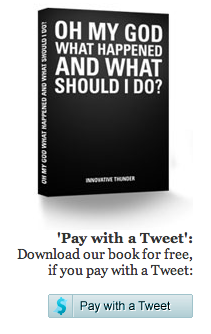
Pay With a Tweet is one of the first services to implement social currency, and it was built by Innovative Thunder.

As the name suggests, this system lets you “pay” for a product with a tweet.

For a customer to get access to a product, they click a button that takes them to a Twitter page. There they tweet the required message to their followers. Next, they’re automatically taken to a download page where they can claim the product in question. Pay With a Tweet has added functionality for Facebook, too.

Here’s how the call to action appears:
Pay With a Tweet

Popshop

Popshop is a new service by SYZYGY that claims to be “Pay With a Tweet on steroids.” Rather than just using Twitter as a sharing medium, it has functionality for other social networks like LinkedIn, Pinterest, Facebook, and Google+.

It’s a free, one-page, customizable WordPress popup shop theme that also features Facebook page integration. Here’s how it looks:

Popshop

If you don't share the deal before you click the Get This Offer button, you see this message:

Popshop message

This ensures that the content gets shared before the users get access to the product.

Why social currency works

Social currency systems are being used more widely by bloggers and site owners, since they work so well. But why?

They appeal to our inner cheapskate

The majority of people have an inner cheapskate. Whenever you choose to buy something, you always have the urge to go for the cheaper option. That's just how our brains work.

Social currency systems have the same effect. The desire for a product is further increased by mentioning the price that the product should cost and explaining that, instead, you're offering it for a far lower price—just a share! It's a common but effective marketing tactic.

They provide a sense of value

This works hand-in-hand with my first point. People are not as drawn to things that are completely free as they are drawn to things that are "practically" free.

When you give your offer a price, no matter how small, it creates a sense of value. Something completely free seems less attractive because most of the time, it’s perceived as being of low quality.

Excellent promotion benefits

Social currency systems can be used by businesses to successfully promote launches and events.

A good strategy for ebook authors, for example, would be to release a "free" report or mini-ebook as a teaser for their final product. In return, they get shares and are able to create a buzz amongst millions of potential customers.

This tactic can also be used by bloggers to make blog posts and videos go viral, and this also drives traffic to their respective sites.

Other ways to use social currency systems

  • Authors can use them to sell excerpts to promote books.
  • Freelancers and job hunters can use them to sell work samples and access to portfolios or resumes.
  • Internet marketers can use them to sell free reports to create a buzz for upcoming webinars.
  • Speakers can use them to sell mini-courses for the promotion of workshops.
  • Consumer brands can use them to sell commercials to make them go viral.
  • Service providers and use them to sell basic versions of services, as a way to promote premium packages.
  • Musicians can use them to sell music demos and singles for upcoming albums.

All in all, social currency systems are underused but have enormous potential not only for promotion, but also for traffic and income generation.

Is social currency for you?

Social currency is gaining momentum. Have you used it already, perhaps to buy something, if not to sell it? Have you tried other social currency systems? Do you think you could use social currency to build buzz around your blog?

Tell us in the comments. We all love to learn.

Nathan Kash (@electricblogger) is a professional blogger who runs Electric Blogging where you can discover methods of traffic generation, writing excellent content, social media utilization and how to blog effectively. He also gives blogging tips to newbie bloggers and seasoned professionals.

Originally at: Blog Tips at ProBlogger
DMS_468x60_LS_banner4.gif

Use Social Currency Systems to Grow Your Blog

Why Bloggers Should Freelance

Posted: 19 Jul 2012 07:04 AM PDT

This guest post is by Sid from GeeksMakeMoney.

Blogging can be a richly rewarding experience, and bloggers can sometimes get carried away by their success. I personally know bloggers who look down upon freelancing, but unless you are one of the top league bloggers known the world over, you should probably expand and diversify.

Freelancing gives you plenty of ways and opportunities to grow beyond the confines of being “a blogger,” and it can be of great help in your blogging career.

Whether you are new to blogging or have been in your field for long, freelancing on the side can open up opportunities and avenues that are not always available to ordinary bloggers. You can always tie your blogging activities into your freelancing activities—it’s not hard to figure out how one feeds off of the other.

The trick is to be open to trying out something new, taking risks and learning in the process.

Monetary flexibility

Well, straight to the point: freelancing pays. Blogging might or might not pay.

If you are a new blogger, this is a fairly obvious point. You can freelance on the side and earn some additional income while your blog is still growing and yet to produce significant income itself.

If you already have a blog that earns money, remember that earnings for most bloggers can fluctuate a lot, especially for the medium-sized blogs. Can you honestly tell yourself that you would earn as much or more from your blog a couple of years from now as you are earning today? There are so many factors—Google algorithm changes, established competition, shifting preferences of the audience and plenty more can devastate small bloggers (think Shoemoney or John Chow—if such A-list bloggers can lose audience, so can you).

With freelancing, you have the flexibility to scale up or down your activities and thus maintain your current income streams even if your blog’s earnings fluctuate.

Success story; Oni of YoungPrePro ties his blog and his freelance writing together really well. In fact, he’s now at a stage where he earns tens of thousands of dollars a month only through freelancing. Even though his blog is hugely popular, he prefers to earn money through freelancing because it is stable, reliable, and better paying.

Branding and publicity

If you can contribute your work to a more popular medium than your own blog, and people like your work, you are building your brand by investing in yourself. Freelancing is also a good medium for publicity, and I love any method that pays me to publicize myself!

Freelancing gives you the opportunity to produce high quality content under your name that others will like, and appreciate and present yourself and your expertise to the world. This, of course, is going to be of immense help to grow your blog as people recognize your authority.

Success story: Carol of Make A Living Writing is a prolific and well-known writer, and has written for Entrepreneur, Copyblogger, Seattle Times, and plenty of other popular blogs.

Many can instantly recognize her and her top-quality work, so freelancing helps her grow as a writer and helps establish a higher credibility for her blog at the same time.

Testing new waters

As a freelancer, you get to work on different fields within your area of expertise. If you are a writer, you can write on a variety of topics. This is a great way to explore new areas that interest you and learn more about different niches. You can pick up ideas that you think a blog in this niche should cover and then present your own perspective.

Many bloggers work for bigger publications, then branch out to start their own blogs once they understand the business and topic much more intimately.

Success story: Starre of Eco-Chick was a writer for popular fashion magazines before starting her own successful blog, which is in line with what she wrote for magazines, combining fashion and sustainability.

When she started the blog Eco-Chick, everything was already in place—she knew the field better than anyone else. Isn't that a solid start for your blogging platform?

Tricks of the trade

In addition to these points, you can also learn insider tricks of the trade when you freelance. When you work as a freelancer and are getting paid to do so, chances are, you are working at a company that is at least moderately successful. You can learn why, and they would be more than happy to teach you because they want your work to be put to best use.

This is a great way to learn how things are done and what works for successful businesses. And that knowledge can prove invaluable when you are actually starting your own blog.

Do you freelance and blog at the same time? Why? And what benefits does it give you? Tell us your stories in the comments.

True to his word, Sid is a blogger and freelancer and has written popular freelancing guides including oDesk Review and Elance vs. oDesk. He is starting out a number of different blogging projects, from understanding fashion to using python in finance. His oldest blog is about penny auctions.

Originally at: Blog Tips at ProBlogger
DMS_468x60_LS_banner4.gif

Why Bloggers Should Freelance