This guest post is by AJ Kumar of Single Grain.
Social media sites are great for a number of different purposes, including connecting with your readership and establishing yourself as a thought leader within your industry. However, the interactions you have on these popular social sites can also serve another major purpose within your business—providing the market research necessary to uncover your audience's hidden pain points.
But what are pain points, and what makes these issues so useful from a marketing standpoint?
Essentially, "pain points" are the problems that members of your audience have that they're actively seeking solutions for. Let's take a closer look at different parts of this statement to see what makes pain points so powerful:
- The problems: When you can identify different issues that your audience is facing, you can also identify and provide the solutions they need. Doing so will increase both your reputation within your niche and your ability to market products that resolve these issues.
- That members of your audience have: As a blogger, you're only one member of your community, which makes it easy to assume that your audience members are experiencing the problems you expect them to have. Unfortunately, limiting your survey of potential pain points to your own assumptions means that you could miss some tremendous opportunities to connect with your readers over problems you never even imagined they'd be facing!
- That they're actively seeking solutions for: Problem-solving is a continuum, which means that people need to acknowledge that they have certain problems and actively seek out a solution before your interventions can be useful. Approaching readers at the wrong point on this spectrum—for example, before they even know they have problems—can make your marketing efforts less successful.
With all of these different factors in mind, here's a simple five-step process for uncovering your audience's hidden pain points and using these problems to connect more effectively through better-targeted blog posts and paid products.
1. Find your audience
Clearly, in order to identify the pain points your audience is expressing on popular social networking sites, you first need to locate your readers!
Now, I'm not just talking about high-tailing it over to Facebook or Twitter, finding a few token users and setting up your pain points marketing plan based on the presence of a few audience members. Instead, what you want to find is the social website where people are actively pouring out their innermost feelings to fellow members of their communities.
Within your niche, this might be Facebook or Twitter—or it might be a forum, message board, or chat site. Don't limit the potential of your market research by observing only surface-level interactions or assuming that the top-tier social networking sites will be the best places to understand your members' inner pain points.
The easiest way to identify your audience's internet hangouts is to pretend to be an audience member yourself. Enter questions into Google as if you were searching for the types of information your site visitors are looking for and pay attention to the sites that appear in the natural search results. Explore these sites and follow any external links you encounter, paying close attention to signs of high engagement (for example, post comments, forum thread views, and social shares).
Once you find the hottest social sites in your niche, take the time to set up a profile for yourself and begin interacting with your audience.
2. Find the keywords they use
As you engage with your potential site visitors on your chosen social networking sites, pay special attention to the way they're asking questions and the keywords they use to do so.
One of the biggest weaknesses facing bloggers who incorporate traditional keyword research into their website marketing plans is that the data found in these number-crunching programs often fails to tell the whole story about your audience's actual interests and desires. The result is a blog that's well-optimized for the search engine spiders, but not your actual readers!
For example, suppose you run a blog in the weight loss industry, and your keyword research turns up good search volume and low competition for the phrase, "easy tips for fat loss." However, if your audience rarely uses the phrase "fat loss"—instead, preferring the words "weight loss"—you could be missing a golden opportunity to target your audience's pain points by failing to optimize your blog for the appropriate words and phrases.
3. Search social media sites for questions and issues
In addition to using social networking sites to uncover potential keyword optimization ideas, you can also search the content that's been posted to your social-site-of-choice in order to uncover your audience's most pressing issues.
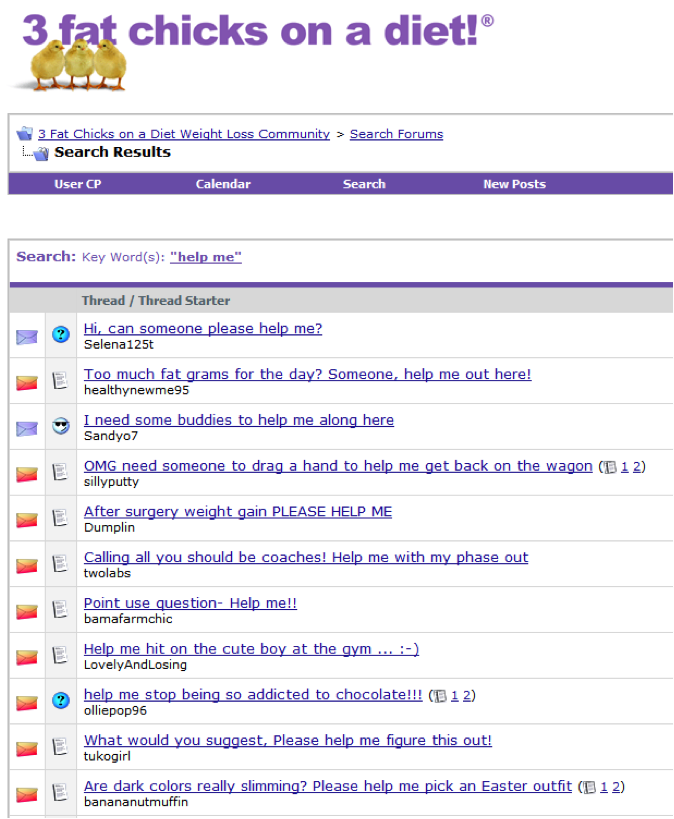
Continuing with our weight loss blog example mentioned earlier, suppose you determine that one of the best social sites in your niche from a market research perspective is 3fatchicks.com—a popular health and fitness forum site primarily targeting women. Entering the phrase "help me" (a good signifier of the issues people are actually facing) into the site's search tool returns the following set of results:

Many of the threads listed here provide great insight into the pain points your audience is currently experiencing—any of which could be turned into future blog posts or paid products. As an example, the forum post titled, "help me stop being so addicted to chocolate!!!" could easily be transformed into a "17 Ways to Beat Your Chocolate Addiction" report that you can practically guarantee will appeal to members of your target niche.
4. Ask your audience questions
If you're having trouble identifying social networking site posts that reveal your audience's pain points, you can also go directly to the source and gather data by asking your audience leading questions.
For example, consider the following sample questions:
- What has been your greatest achievement to date?
- What invention would help you most right now?
- What one thing would you like to give up forever?
- What would you do right now if you were handed $1,000?
- If you could change any one thing about yourself, what would it be?
Just a word of caution, though: for best results, it's best to use this technique only after you've already established yourself as a valuable member of your social networking community. Attempting to ask leading questions when you've just joined a new online community can result in either a serious lack of responses or the perception that you're scamming your chosen social networking site.
5. Develop blog posts and info products based on stated issues
By following the steps above, you should have uncovered a wealth of information about your audience's hidden pain points that can be directly transformed into effective blog posts and paid products.
However, keep in mind that market research on your audience's issues should be an ongoing part of your blog's promotional plan. Changes occur in every industry, whether in terms of new websites launching, new technologies being released or any other type of innovation, which means that the problems your audience faces will change as well.
For best results, check in with this process frequently and pay attention to the reaction you get to the posts and products you release targeting the pain points you've uncovered. Use this insights to tweak your future launches, and—over time—the insight you gain into your audience's hidden motivations will make you a far better blogger and a much more respected member of your community.
AJ Kumar is co-founder of Single Grain, a digital marketing agency< based in San Francisco. Single Grain specializes in helping startups and larger companies with search engine optimization, pay-per-click, social media, and various other marketing strategies.
Originally at: Blog Tips at ProBlogger

Find Fans’ and Followers’ Pain Points in 5 Simple Steps